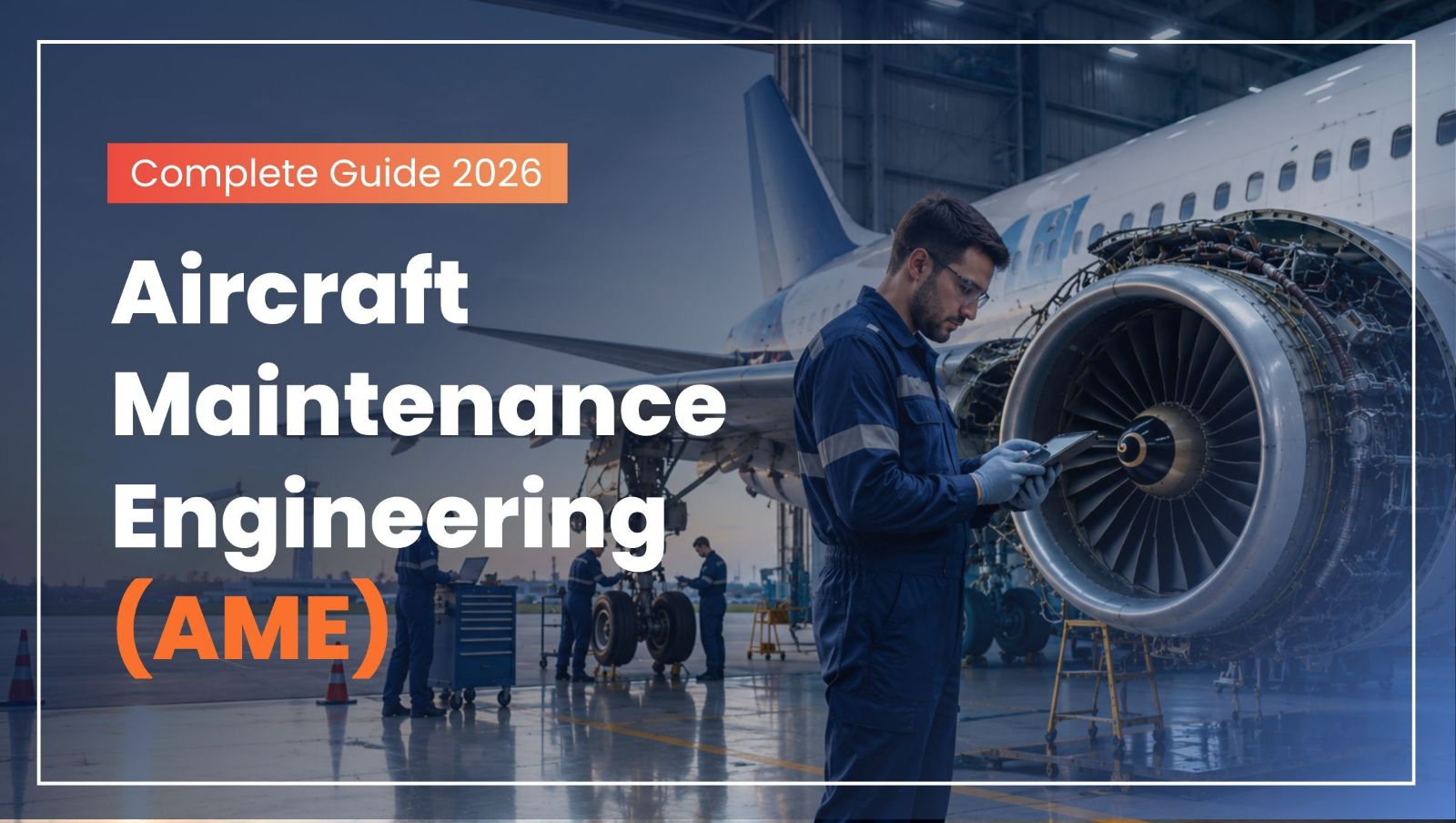
Aircraft Maintenance Engineering (AME): Complete Guide 2026
Introduction
Ever wondered about the people responsible for ensuring the safety of an aircraft before takeoff? Though pilots operate the aircraft, there is another group of individuals who are assigned an even greater responsibility—that of ensuring the safety of every aircraft. Such professionals are known as Aircraft Maintenance Engineers (AMEs).
Every day, so many aircrafts transport millions of passengers across the globe. Before every flight, the aircraft go through a number of inspections and maintenance processes to ensure that they meet the safety standards assigned by the aviation authority. In this regard, Aircraft Maintenance Engineers play a pivotal role in aviation safety.
Do you have great passion for aviation but are not keen on flying as a career? Then you can consider the career option of Aircraft Maintenance Engineering. This is one field which requires not only technical knowledge but also analytical skills and practical experience as well.
There has been rapid growth in the aviation industry in India in recent times. Many new airports have come up and airline companies have expanded their aircraft fleet. Consequently, the need for trained professionals in aviation has increased considerably both in India and elsewhere.
In this guide, we will cover all you need to know regarding Aircraft Maintenance Engineering in 2026 like eligibility and admissions, careers, salaries, licensing, and future scope, everything will be covered. If you are a student who has recently finished your Class 12 or is seeking information on a possible career in aviation, then this guide will surely come in handy for you.
What is Aircraft Maintenance Engineering (AME)?
AME is a distinct branch of aviation that concerns itself with checking, servicing, repairing, and certifying aircraft to make sure they can be operated safely. Contrary to most other branches of engineering, the Aircraft Maintenance Engineer bears a lot of responsibility since passenger safety is at stake.
Each and every aircraft requires periodic checkups both prior to and post flight. The inspections are made in accordance with certain aviation standards set by the Directorate General of Civil Aviation in India and throughout the world.
The job of the Aircraft Maintenance Engineer is not only limited to the fixing of broken down parts but involves the anticipation of any future problem before it occurs. The engineer inspects different systems of the aircraft including engines, landing gear, hydraulics, electricity, avionics, and structure.
Among the things that make this occupation unique is the fact that the certified AME has the power to issue a certificate on whether an aircraft is airworthy or not. Without the certificate, an aircraft will not be able to fly legally. Thus, AMEs are considered some of the most trusted individuals in the aviation industry.
Aircraft Maintenance Engineering is one of the best professions for people who are interested in technology, mechanics, physics, and troubleshooting technical issues. As aircraft technology changes every day, AMEs continue to upgrade their knowledge to handle new aircraft systems.
Why is Aircraft Maintenance Engineering Important?
When you get on a plane, it’s a sure thing that your aircraft has been checked over thoroughly, and your ride will be safe. The reason we are assured of this safety is the hard work done by Aircraft Maintenance Engineers, who make sure that the aircraft is maintained within the safety regulations.
Modern aircrafts are very complex machines, with many interrelated parts. A small malfunction that goes unnoticed may affect the performance of the entire machine. This explains why aircraft maintenance is non-negotiable.
Routine aircraft inspections prior to flights, scheduled maintenance, troubleshooting, replacement of faulty parts, and system tests are among the responsibilities of Aircraft Maintenance Engineers. All this makes the aircraft comply with the highest standards of safety.
In the aviation industry, preventive maintenance is practiced as opposed to reactive maintenance. Engineers undertake regular inspections of aircrafts depending on flight hours and operating cycles.
Apart from ensuring passenger safety, another significance of Aircraft Maintenance Engineering is that it helps airlines to save on cost, increase fuel efficiency, increase the longevity of the aircraft, and reduce delays due to technical problems.
To put it simply, Aircraft Maintenance Engineers form the basis of safe aviation operations. Without their skillful knowledge, commercial aviation would not exist at all.
Why Choose Aircraft Maintenance Engineering in 2026?
The aviation industry is going through one of its fastest growing periods, thereby making 2026 a great time to start a career in Aircraft Maintenance Engineering.
India has emerged as one of the fastest-growing aviation markets across the globe. Growing demand for air travel, investments by the government in improving airport infrastructure, growth of domestic airlines, and growth of aircraft maintenance facilities are offering great career prospects.
There are many reasons why AME is a great career option:
Growing Aviation Industry
The number of people travelling by air each year keeps on increasing. The airlines have been increasing their fleet of planes in order to satisfy this demand, leading to more demand for maintenance technicians.
Construction of Airports
The Indian government has been making a lot of investment in building new airports and improving the existing ones. Each new airport generates jobs in aircraft maintenance, ground handling, and technical jobs.
Increasing Need for Qualified Engineers
The aircraft have to undergo maintenance work throughout their lives. With growing fleets of airlines, the requirement for aircraft maintenance engineers increases as well.
Job Prospects Abroad
There are international standards for carrying out the maintenance of aircraft. Qualified AMEs can get work in airlines and aviation companies around the world.
Advancements in Technology
Modern planes are equipped with advanced digital technology, composite materials, and avionics. This presents an amazing opportunity for engineers interested in dealing with state-of-the-art technology.
Satisfaction at Work
Very few careers have the kind of responsibility and sense of pride associated with ensuring passengers' safety. An Aircraft Maintenance Engineer realizes the significance of his/her job every day.
Types of Aircraft Maintenance Engineering
Maintenance Engineering for Aircraft is broken down into various streams where students can specialize in specific fields of aircraft maintenance.
Stream Mechanical
The stream mechanical emphasizes the physical parts of the aircraft.
It involves:
Structures of the aircraft
-
Jet engines
-
Piston engines
-
Landing gears
-
Hydraulic systems
-
Pneumatic systems
-
Flight controls
-
Fuel systems
It is the responsibility of the mechanical engineers to make sure that every moving part of the aircraft works well.
Stream Avionics
The stream avionics is all about the electronics and electricity of the aircraft.
They include:
-
Navigation systems
-
Communication devices
-
Radar systems
-
Flight instruments
-
Aircraft computer
-
Electrical systems
-
Automated flight systems
-
Displays
Avionics engineers are vital in today’s aviation because of the increased use of electronics in aircraft.
Responsibilities of an Aircraft Maintenance Engineer
The job role of Aircraft Maintenance Engineers entails a broad range of duties to ensure that aircraft are kept in a safe and functional state.
Some of their key roles are:
-
Routine inspection
-
Problem identification
-
Repairing faulty aircraft parts
-
Replacements of damaged parts
-
Preventive maintenance
-
Engine inspection
-
Inspection of aircraft structure
-
Electricity and electronics system testing
-
Maintenance documentation
-
Compliance with DGCA safety guidelines
-
Airworthiness certification
Their job demands extremely high levels of concentration as any mistake made by them may lead to disastrous results.
DGCA Approval and Why It Matters
In the case of searching for Aircraft Maintenance Engineering Courses, one will often come across the terminology 'DGCA Approved'. Knowing the significance of this terminology is very important prior to choosing any institute.
The Directorate General of Civil Aviation (DGCA) is the regulator in India which takes care of civil aviation. It lays down safety norms in aviation, airworthiness, licensing, and maintenance procedures.
An institute approved by DGCA as a DGCA AME institute is an institute which conforms to all the standards and requirements set by the DGCA. It is important as this would help students get proper knowledge according to industrial standards.
The institute would give students proper practical training and exposure to various aspects of aviation maintenance.
It is very important that the institute is approved by the DGCA and has proper training facilities. Selecting the proper institute is one of the most crucial steps in Aircraft Maintenance Engineering.
Skills Needed to Become an Aircraft Maintenance Engineer Success in Aircraft Maintenance Engineering is not only about knowledge but also about skills, discipline and a high degree of responsibility.
The main skills required in Aircraft Maintenance Engineering include the following:
Attention to Detail
There are numerous components inside an aircraft. The ability to notice small details allows engineers to find potential problems and solve them before they cause serious trouble.
Technical Understanding
Engineers need to understand mechanical, electronic, and other systems of an aircraft to solve any possible technical problem.
Problem-Solving Skills
Engineers face many technical problems while working with aircraft. They need to think logically and be able to troubleshoot.
Good Communication Skills
Aircraft Maintenance Engineers work with pilots, inspectors, technicians and airline personnel.
Working in Teams
Aircraft maintenance is usually not performed by a single person. Engineers work together with other specialists from various departments to finish their tasks.
Time Management
Most aircraft maintenance procedures need to be finished in accordance with certain schedules to prevent delays and guarantee maximum safety.
Safety Commitment
In addition to everything else, it should be mentioned that safety is always the priority for an Aircraft Maintenance Engineer.
Eligibility Criteria for Aircraft Maintenance Engineering (AME)
One of the major benefits of taking up Aircraft Maintenance Engineering is that one can begin working towards their aviation career right after class 12. There are some eligibility criteria that must be known by all those who want to join this field.
Educational Qualifications
For an AME program, applicants need to have completed 10+2 (equivalent) with:
-
Physics
-
Chemistry
-
Mathematics (PCM)
In some cases, those having passed a diploma course in Mechanical, Electrical, Electronics or Aeronautical Engineering can also be admitted, as per the institute’s admission policy.
Age Criteria
Generally, candidates must be at least 16 years of age while applying to such programs. There are usually no upper age limits, but it is better to confirm with the institute one plans to join.
Medical Fitness
As AMEs operate in highly technical conditions, it is important that individuals must possess good medical fitness. Individuals with good eyesight, perfect color vision, and physical fitness are preferable, particularly those planning to acquire their DGCA licenses in the coming years.
Passion for Aviation
Although educational qualifications may carry a lot of importance, passion for aviation, technology, and aircraft systems goes a long way in contributing to success in this field. Students who have an affinity for dealing with technical issues and machines make for good AMEs.
Aircraft Maintenance Engineering Admission Process 2026
Admission in AME colleges is simple; however, picking the right college is one of the most crucial decisions you will ever make.
Here are some common steps of admission procedure:
Step 1: Selecting Institutes
Select those institutes which have good infrastructure, qualified faculty, practical education, and industrial exposure. It is always advisable to check the recognition of the institute and the training facilities before applying.
Step 2: Checking Eligibility
Check your eligibility criteria before filling the application form.
Step 3: Applying
It is mostly seen that almost all institutes have made it convenient for the students to apply online by filling an application form and submitting the required documents.
Documents submitted may include the following:
-
Class 10 Marksheet
-
Class 12 Marksheet
-
Passport size photographs
-
Proof of identity
-
Transfer certificate (if any)
Step 4: Entrance Exam/Interview
Few institutes have an entrance test or personal interview to test the aptitude and interest of the candidate in Aviation.
Step 5: Admission Confirmation
The candidate can confirm his admission after the verification of the documents.
Duration of the AME Course
AME, which stands for Aircraft Maintenance Engineering, is an aviation course that involves both theoretical and practical aspects of study.
Even though there could be variations in the number of years one takes to complete the course due to different training setups, the typical components of the course are as follows:
-
Classroom based study
-
Practical classes
-
Aircraft maintenance training
-
Industrial exposure
-
Preparing for examinations for DGCA licenses
Unlike other courses in engineering, AME is a course that focuses greatly on practical knowledge.
What Will You Study During the AME Course?
The AME curriculum is structured to ensure that the students gain theoretical knowledge and practical skills.
Some of the main subjects covered are:
Aircraft Structures
The students get to learn about aircraft structure design, fuselage, wings, control surfaces, material use in manufacturing of aircraft, and structural inspections.
Aircraft Engines
The students get to learn about:
-
Jet engines
-
Turbofan engines
-
Turboprop engines
-
Piston engines
-
Engine maintenance
-
Engine performance
Aircraft Systems
Aircraft comprises many systems that are integrated together.
These include:
-
Hydraulic systems
-
Pneumatic systems
-
Fuel systems
-
Landing gears
-
Flight controls
-
Environmental control systems
Electrical Systems
The current generation of aircraft depends much on electricity.
These include:
-
Electrical circuits of aircraft
-
Wiring systems
-
Battery systems
-
Alternators
-
Generators
-
Power distribution systems
Avionics
Avionics studies various systems based on electronics to operate an aircraft.
These include:
-
Navigation systems
-
Communication systems
-
Flight instruments
-
Radar systems
-
Automatic flight controls
-
Digital cockpits
Aviation Regulations
There are strict regulations regarding aircraft maintenance.
These include:
-
DGCA regulations
-
Aircraft paperwork
-
Safety practices
-
Regulations of maintenance
-
Human factors
-
Aviation laws
Maintenance Practices
This practical subject teaches students how to:
-
Conduct inspections
-
Handle maintenance tools
-
Understand aircraft manuals
-
Conduct maintenance procedures
-
Document maintenance activities
Practical Training: The Key to AME Training
One of the most important distinctions about Aircraft Maintenance Engineering training compared to other technical programs is practical training.
Unlike other subjects which take place entirely within the classroom, AME students have the opportunity to gain invaluable practical knowledge by interacting with aircrafts, aircraft parts, and professional maintenance equipment.
Practical training enables students to learn about the application of theoretical knowledge in the practical world of aviation.
Practical training may enable the student to learn how to:
-
Conduct pre-flight inspection of aircraft
-
Detect mechanical faults
-
Conduct scheduled maintenance of aircraft
-
Replace parts of the aircraft
-
Test aircraft systems
-
Handle aviation maintenance tools
-
Refer aircraft maintenance manuals
-
Maintain safety standards
Importance of Industrial Exposure
Classroom learning is one thing, but practical experience within the aviation industry offers a lot more insight into how aircraft maintenance functions.
Practical exposure enables students to learn from experienced engineers, gain knowledge about maintenance of airlines and familiarise themselves with professional work environments.
Various institutes offer students the chance to visit:
-
Aircraft maintenance shops
-
Aviation workshops
-
Airport maintenance shops
-
Maintenance, Repair and Overhaul (MRO) organizations
These kinds of visits make up for the shortcomings of classroom learning.
Understanding the DGCA License
Achieving a DGCA Aircraft Maintenance Engineer License is one of the major landmarks in an AME’s career.
This license is granted once the applicants fulfill the necessary educational and training criteria and pass the prescribed exams.
The holder of the DGCA Aircraft Maintenance Engineer license can validate that the aircraft is airworthy post-maintenance. This is important as it directly impacts flight safety.
Getting a DGCA license indicates professional capability and leads to career options within airlines and aviation companies.
Course Fees for Aircraft Maintenance Engineering
The cost associated with doing AME courses is dependent on various aspects such as the institute chosen, facilities available, infrastructure, training options, and additional facilities offered to the students.
While choosing an institute, students must not only compare the fee structures but must also judge the overall worth that they are getting.
Key aspects to be considered include:
-
Experience of teaching faculty
-
Availability of modern labs
-
Facilities for practical training
-
Aircraft for training purposes
-
Industrial exposure
-
Placement help
-
Support services for students
The quality of the institute chosen is of far more importance than just cost alone.
How to Choose the Right AME College
The choice of the proper college may affect one’s studies, industry exposure, and even career growth. Before taking any decision, you should make an effort to compare colleges properly.
Below there is a list of criteria that may be useful during comparison:Recognition and Accreditation
Make sure that the college meets all the requirements regarding the standard of aviation training and education.
Experienced Educators
It is better to study under the supervision of professional aviation educators to get a deep understanding of theory and practice.
Practice-oriented Resources
A good institution should offer access to aircraft, workshops, laboratories, and maintenance equipment.
Industry Contacts
Colleges having good relations with airlines, MROs, and other aviation companies may offer more opportunities to their students.
Career Support
Career counseling, job interviews, internships, and placement may help to enter the aviation industry easily.
Students’ Opinions
Talking to current students and graduates is very important to get the picture of the educational process.
Common Challenges Students Face During the AME Course
As with any other professional course, Aircraft Maintenance Engineering needs dedication and consistent learning.
Some of the hurdles that students face could be:
-
Knowledge of complicated aircraft systems
-
Technical language comprehension
-
Theory and practice classes balancing
-
Adherence to maintenance standards
-
Licensing test preparation
But through constant practice, expert advice from faculties, and true passion for aviation, these hurdles can be overcome.
Career Opportunities After Aircraft Maintenance Engineering (AME)
The other main reason students join the field of Aircraft Maintenance Engineering is the variety of job prospects it offers in the aviation sector. With the increase in air travel in India and abroad, there has been an increased demand for AMEs as well.
After gaining the qualification and license, an AME doesn’t have to be confined to just the airlines but can pursue his or her career in organizations involved in aircraft maintenance, manufacturing firms, aviation authorities, defense organizations, private aviation, and even international airlines.
Here we will consider some of the commonly pursued career paths after the completion of an AME course.
Aircraft Maintenance Engineer
This is the most coveted career path after acquiring the necessary qualification and license. The aircraft maintenance engineers inspect, troubleshoot, repair and certify aircraft for their airworthiness.
They are directly responsible for the safety of the passengers and the aircraft.
Line Maintenance Engineer
Line Maintenance Engineers conduct routine checks before and after flights. They make the aircraft airworthy for its next trip by troubleshooting technical issues within a set turnaround time.
Base Maintenance Engineer
Whereas line maintenance requires little inspection and servicing, the latter process requires an in-depth inspection and servicing of the aircraft which may take several days.
Engineers undertake extensive repairs, structural inspections, engines' maintenance, and system tests.
Quality Assurance Engineer
Quality Assurance Engineers oversee the compliance with aviation regulation and industry standards in terms of maintenance. They carry out audits, check maintenance records and ensure safety standards.
Maintenance Planning Engineer
All aircraft have maintenance schedules. Maintenance planning engineers coordinate inspections, spare parts, manpower, and the entire maintenance process to ensure the maintenance of aircraft operation.
Technical Services Engineer
Technical Services Engineers review aircraft operations, identify recurrent technical problems and suggest maintenance measures that enhance efficiency.
Aircraft Manufacturing Industry
Engineers in this sector examine new aircraft, carry out tests, and monitor quality standards of manufacturing processes.
Maintenance, Repair and Overhaul (MRO) Companies
These firms are focused on carrying out maintenance services for aircraft owned by airlines and other aviation organizations. They hire many Aircraft Maintenance Engineers.
Top Recruiters for AME Graduates
Aircraft Maintenance Engineer (qualified) can seek career options in airlines, MRO agencies, aircraft manufacturing firms, cargo airlines, business aviation firms, and governmental bodies.
Some of the popular recruiting agencies are as follows:
-
Air India
-
IndiGo
-
Akasa Air
-
SpiceJet
-
Air India Express
-
Alliance Air
-
Air Works
-
GMR Aero Technic
-
AirAsia (wherever applicable)
-
Airbus
-
Boeing
-
Hindustan Aeronautics Limited (HAL)
-
Numerous DGCA-approved MRO agencies
With the growth of the aviation industry, new career options are anticipated to crop up in different areas.
Salary After Aircraft Maintenance Engineering
The salary varies due to many considerations, including the qualification level, practical experience, certification, employment, and location of work.
Normally, experts with more experience and higher certification earn much better salaries.
|
Experience Level |
Average Annual Salary |
|
Fresher |
₹4–6 LPA |
|
2–5 Years |
₹6–10 LPA |
|
Experienced Licensed AME |
₹10–18+ LPA |
|
International Opportunities |
Can be significantly higher depending on the employer and country |
*These figures are approximations and may vary depending upon the organization, location, position, and level of experience.
Apart from salary, most employers also provide some other additional benefits such as health insurance, travel allowance, performance bonuses, and career development programs.
Future Scope for Aircraft Maintenance Engineer
The future scope for Aircraft Maintenance Engineering is very bright.
There is steady growth of the aviation industry in India along with increased passengers, airlines route, airports, and maintenance facilities for aircraft.
Some of the important drivers for future scope can be listed as follows:
Growth of Airline Fleet
The airlines add new aircraft due to increased air passengers' traffic, and each aircraft will need regular inspections and maintenance throughout its life span.
Development of MRO Industry
There is development of aircraft Maintenance, Repair and Overhaul (MRO) industry in India. Thus, there is more employment scope for Aircraft Maintenance Engineers.
Global Scope
Licensed Aircraft Maintenance Engineers have global scope due to their universal safety standards for aircraft maintenance.
Advancements in Aircraft Technology
Today's aircraft use highly advanced technology including avionics, digital, automated and composite materials. Engineers that keep upgrading themselves would always find good career opportunities.
Cargo and Business Air Transport
The expansion of cargo flights and business aircraft has resulted in a greater demand for maintenance engineers.
All in all, Aircraft Maintenance Engineering remains one of the most secure professions in the aviation industry.
Aircraft Maintenance Engineering vs Aeronautical Engineering
Many people tend to confuse Aircraft Maintenance Engineering with Aeronautical Engineering. While both have similarities, there is a vast difference between the two.
|
Aircraft Maintenance Engineering |
Aeronautical Engineering |
|
Focuses on inspection, maintenance, repair, and certification of aircraft |
Focuses on aircraft design, research, manufacturing, and development |
|
More practical and hands-on |
More theoretical and design-oriented |
|
Includes extensive aircraft maintenance training |
Includes engineering design and analysis |
|
Can lead to aircraft maintenance licensing after meeting regulatory requirements |
Does not provide maintenance certification authority |
|
Career opportunities in airlines, MROs, maintenance organizations |
Career opportunities in aircraft design, manufacturing, research, and aerospace companies |
For students who want to get involved with planes and make sure flights are safe, Aircraft Maintenance Engineering will be a better option than Aeronautical Engineering.
Why Choose IIAME Delhi for Aircraft Maintenance Engineering?
Selecting the proper institute is one of the crucial steps in the aviation career of yours. A good educational setting will not only make you technically knowledgeable but also make sure that your career in the aviation field succeeds.
IIAME Delhi is a unit of Shaurya Aeronautics Pvt. Ltd. (SAPL) with 25+ years of experience in the aviation sector. It is an DGCA Approved college offering different aviation courses for the interested students.
In IIAME Delhi, the students get an education which is a blend of classroom learning along with practical exposure, so as to develop the skills needed in the aviation sector. We also have a practical campus which is Dr B.R. Ambedkar Airstrip, Partapur, Meerut, Uttar Pradesh.
The following are some of the advantages:
-
Curriculum oriented towards the industry
-
Qualified teachers
-
MRO training
-
100% placement assurance
-
Practical training in our practical campus
-
Laboratories and workshops
-
Good learning atmosphere for the students
-
Career guidance and placement support
-
Focus on technical skills and professionalism
The institute tries to make sure that the students have confidence, practical knowledge, and rewarding careers in the aviation field.
Frequently Asked Questions (FAQs)
1. What is Aircraft Maintenance Engineering?
It is a professional aircraft maintenance engineering program in which one inspects, maintains, repairs, and certifies aircraft for flight.
2. Who can apply for the AME Course?
Those students who have done 10+2 in Physics, Chemistry, and Mathematics can apply for it. It varies from college to college.
3. Is Aircraft Maintenance Engineering a good career?
Yes. As the aviation sector is growing day by day, AME is one of the best careers with great scope.
4. Is mathematics compulsory for AME?
Yes, Physics, Chemistry and Mathematics are the compulsory subjects at 10+2 for most of the colleges.
5. What are the qualities of an Aircraft Maintenance Engineer?
Important qualities are attention to detail, technical know-how, problem-solving ability, communication, team work and safety.
6. Do girls have any chance to be trained as Aircraft Maintenance Engineers?
Of course, the Aircraft Maintenance Engineer training program welcomes all qualified candidates including women and many successful women are working in this field.
7. How long does the training program last?
The training program may differ in relation to the format and the college chosen by you. Normally, the program includes both theoretical and practical training.
8. Can Aircraft Maintenance Engineers work in foreign countries?
Yes, experienced and certified AMEs are able to work abroad in various airlines and aircraft maintenance services.
9. Is there any practical training involved in the training program?
Yes, practical training is one of the most important parts of the Aircraft Maintenance Engineer training program.
10. Which companies employ AMEs?
Such companies as airlines, aircraft maintenance services, aircraft manufacturing companies, cargo airlines, business aviation companies, and government aviation organizations recruit AMEs.
Conclusion
An Aircraft Maintenance Engineering course is not simply a technical subject; rather, it is a career based on accountability, accuracy, and safety. No successful journey in aviation is possible without professional pilots and engineers who make sure the aircraft are safe.
Due to the rapid expansion of India's aviation industry and the growing need for qualified maintenance experts across all over the world, choosing the AME course in 2026 may be the best decision for the students who are passionate about aviation and technology.
Aircraft Maintenance Engineering seems to be an ideal career for those who would like to get hands-on knowledge, various opportunities, and work with complex aircraft engineering systems.
A successful start of an aviation career starts with making a good choice of the institute, receiving a high-quality education and training, and continuous learning.
Ready to Make Your Passion for Aviation a Profession?
Are you eager to work with airplanes and make your contributions to the field of aviation safety? The Aircraft Maintenance Engineer (AME) course may be just what you need. Students at IIAME Delhi have the opportunity to get a quality education that will help them enter their chosen profession in the field of aviation.
Want to know more about admissions for the AME course, its eligibility criteria, fees, scholarships, and job opportunities? Our admission counselors will be glad to answer all of your questions. Reach out to IIAME Delhi now and start your aviation career.